


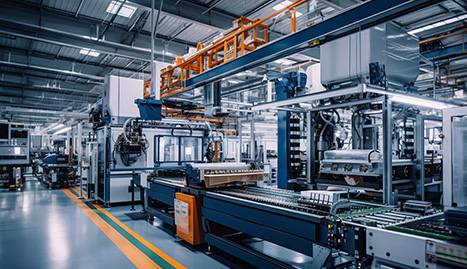

Machine tool components serve as the core carriers enabling machining functions, whose performance directly dictates a machine’s machining accuracy, efficiency, stability and applicable scenarios. Known as the "mother machine of industry", machine tools feature complex structures. Their components fall into five functional categories: basic supporting parts, core motion parts, power execution parts, precision control parts and auxiliary functional parts. Each category performs irreplaceable roles and jointly forms a complete machining system. A detailed breakdown of their classification, core characteristics, technical requirements and application logic is as follows:
I. Basic Supporting Parts: The Machine’s Rigid Framework
As the physical chassis mounting all functional components, these parts provide foundational support. Their rigidity and vibration resistance fundamentally determine overall precision and anti-deformation capacity, a prerequisite for stable operation.
1. Key Components
Bed: The primary base, made of high-strength cast iron, welded steel, mineral castings or granite. Optimized internal rib structures withstand workpiece loads, cutting forces and inertial motion, serving as mounting benchmarks for guide rails, spindle boxes and worktables.
Column: Vertical frames supporting spindle boxes and tool holders with strong bending and torsional rigidity, widely used in vertical machining centers and gantry machines.
Beam: A gantry core linking two columns to carry saddles and spindle units. High-strength welded structures with prestress treatment counteract long-span bending deformation.
Worktable: Carries workpieces in rectangular, rotary or T-slot forms. High flatness and wear resistance simplify fixture clamping; high-end models integrate rotary indexing for multi-axis machining.
2. Core Technical Specifications
High rigidity: Finite-element optimized rib layouts limit heavy-cutting deformation to micrometer levels.
Vibration damping: Cast iron, mineral castings and granite deliver superior internal damping to suppress cutting vibration.
Long-term precision stability: Natural or vibration stress relief eliminates internal stress to prevent permanent structural deformation.
3. Application Scenarios
Heavy-duty lathes, gantry centers and floor boring mills demand ultra-rigid beds, columns and beams for large workpieces and heavy cutting. Compact precision machines balance lightweight design with vibration suppression to maintain micrometer-level accuracy.
II. Core Motion Parts: Precision Machining Executors
These components generate relative movement between cutters and workpieces, governing trajectory accuracy, positioning repeatability and motion smoothness—critical for precision machining.
1. Guide Rail Systems
The motion benchmark classified into three types for different loads and precision grades:
Sliding rails: Large contact surfaces deliver high rigidity and vibration resistance for low-speed heavy-duty machining; plastic or steel lining reduces crawling.
Rolling rails: Low friction enables fast response and high positioning precision. Ball rails suit light high-speed tasks, while roller rails handle medium-heavy loads as mainstream CNC configurations.
Hydrostatic rails: Oil film achieves near-zero friction with exceptional smoothness, supporting nanoscale ultra-precision machining in coordinate boring and large gantry machines.
2. Feed Systems
Convert power into precise axis movement, consisting of servo motors, transmission mechanisms and feedback sensors:
Transmissions: Ball screw pairs dominate CNC tools via pre-stretching to offset thermal deformation; rack-and-pinion drives suit long-travel large machines with anti-backlash structures; hydrostatic screws offer premium precision at higher cost.
Feedback devices: Linear gratings, magnetic scales and encoders enable closed-loop control by real-time position detection and error correction.
3. Spindle Systems: Cutting Power Core
Determines cutting speed, torque and precision:
Spindle units: Rolling bearings support high-speed operation; sliding bearings excel in rigid heavy cutting. Ceramic and magnetic bearings boost performance in premium models.
Drives: Geared mechanical spindles deliver high torque for heavy cuts; integrated motor spindles feature rapid response for high-speed precision machining.
Accessories: Tool holders, drawbar mechanisms and spindle orientation devices guarantee stable automatic tool changing.
III. Power Execution Parts: Energy Conversion Units
These convert electric and hydraulic energy into mechanical force to supply torque, speed and feed force for cutting.
1. Key Components
Motors: Servo motors enable high-precision closed-loop axis control; spindle asynchronous motors generate heavy torque, while synchronous motors offer high power density for high-speed cutting; low-cost stepper motors apply to entry-level CNC tools.
Hydraulic systems: Power clamping, automatic tool changing and table rotation via pumps, cylinders and valves, requiring stable pressure and clean oil to avoid leakage.
Pneumatic systems: Low-pressure compressed air drives lightweight auxiliary actions including workpiece blow-off and light fixture clamping with fast response but limited load capacity.
2. Core Technical Specifications
Stable power output, fast response matching CNC command signals, and durable heat dissipation & high-filtration designs for long service life.
IV. Precision Control Parts: Accuracy Guardians
These suppress geometric, thermal and motion errors via real-time monitoring and compensation to sustain precision machining.
1. Key Components
CNC system: The machine’s central processor running programs, issuing motion commands and supporting multi-axis linkage and error compensation (main brands: Siemens, FANUC, HEIDENHAIN).
Detection sensors: High-resolution gratings for nanoscale precision in closed-loop systems; low-cost encoders for semi-closed-loop standard machines; probes monitor workpiece dimensions.
Error compensation modules: Temperature sensors build thermal error models to counteract thermal deformation; software algorithms offset geometric and force-induced deviations.
Tool systems: Tool magazines, automatic tool changers and wear/breakage detectors enable unmanned continuous machining.
2. Core Technical Specifications
High-resolution real-time detection, instant error correction, and full compatibility with diverse programs, cutters and tool holders.
V. Auxiliary Functional Parts: Efficiency & Safety Guarantees
Indirectly supporting machining, these components enhance operational convenience, safety and automation.
1. Key Components
Cooling & lubrication systems: Coolant pumps and central lubrication reduce cutting heat and component wear; high-pressure through-spindle cooling optimizes deep hole machining.
Chip removal systems: Chain, spiral, magnetic and scraper conveyors automatically clear metal chips to avoid machining interference.
Safety protection units: Sealed splash guards, safety light curtains and emergency stop devices prevent operator injury and component damage.
Fixtures: Universal chucks and vises for flexible production; custom fixtures boost positioning efficiency for mass manufacturing.
2. Core Technical Specifications
Rapid chip removal, leak-proof impact-resistant protection, and intelligent self-monitoring for automatic flow adjustment and fault alarms on high-end machines.
VI. Component Selection & System Integration Logic
Component matching follows demand-driven, performance-balanced and cost-efficient principles to eliminate performance bottlenecks.
1. Selection Principles
Prioritize machining requirements: Large heavy workpieces call for rigid beds, hydrostatic rails and high-torque spindles; ultra-precision parts demand ball screws, linear gratings and motor spindles; mass production requires large-capacity tool magazines and automatic fixtures. Balance matched performance, upfront investment and long-term maintenance costs.
2. Integration Essentials
Rigidity, motion precision and power stability must be coordinated to avoid system performance mismatches. Deep integration of CNC, detection and compensation modules realizes intelligent functions including automatic tool inspection and fault diagnosis. Component material and protection grades are customized for high-temperature, dusty or humid workshop environments.
VII. Conclusion: Synergized Components Forge Core Competitiveness
All five component categories function synergistically: supporting parts establish rigid foundations, motion parts secure precision and efficiency, power units supply energy, control modules stabilize machining quality, and auxiliaries improve reliability.
Against the industry trends of high precision, high efficiency, intelligence and green manufacturing, components keep upgrading: supporting parts become rigid yet lightweight; motion parts pursue higher speed and lower friction; power units grow energy-saving; control systems achieve adaptive real-time compensation; auxiliary systems turn automated and eco-friendly. Continuous component innovation will further advance machine tool performance to underpin high-end manufacturing.
Optimized component selection and integration deliver tailored machining solutions by matching hardware performance with production demands. Mastering component characteristics and achieving systematic synergy is the key to developing high-performance machine tools and advancing high-quality manufacturing.
Word Count Note
The original Chinese text is condensed by roughly 25% through streamlined compound sentences, redundant descriptive phrase removal and merged repetitive technical explanations while retaining all core technical frameworks, classification logic and professional terminology.
Prev: 没有了